On July 23rd, the Green Forward Program brought together leading Business Support Organizations (BSOs) for an in-depth workshop titled “Building a Supportive Ecosystem for Green Startups & Public-Private Partnerships.” The event served as a pivotal moment in the Green Launchpad track, aimed at enhancing the support mechanisms available to early-stage green entrepreneurs in Palestine.
This workshop tackled a core challenge: how can we build a more effective ecosystem that meets the unique needs of green startups—those operating at the intersection of sustainability, innovation, and market risk? Participants explored ecosystem gaps in areas such as incubation, funding, policy alignment, and market access, while engaging in collaborative activities to co-design interventions that drive systemic change.
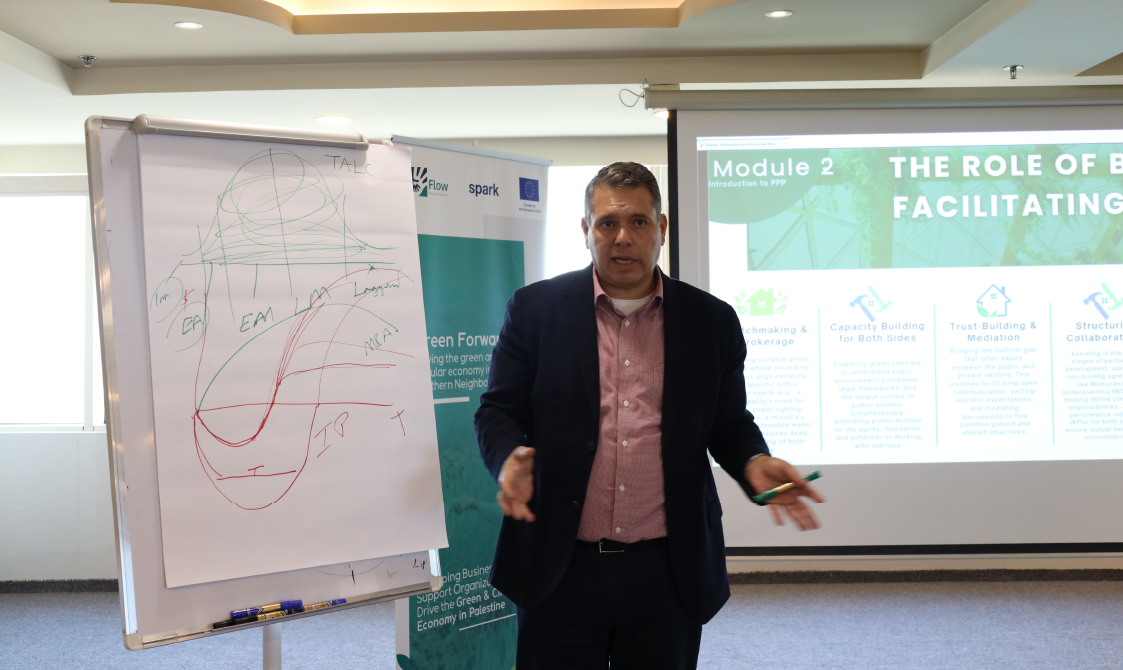
The core training of the day was led by Laith Kassis, ecosystem expert and Managing Director of EnterVentures. Drawing on two decades of experience in public-private collaboration and innovation-driven development, Laith delivered a multi-part workshop designed to shift how BSOs understand their role in supporting green entrepreneurship.
The training began by reframing the definition of a green startup, MSME and SME—not only as a business with environmental goals, but as one that operates within a more complex set of value chains, financing needs, and policy dependencies. Participants explored the distinctive challenges these businesses face, including regulatory uncertainty, lack of mission-aligned investment, and the absence of tailored incubation pathways. Through small group activities, BSOs mapped real gaps in the Palestinian ecosystem and debated how to evolve their own service models.
In the second segment, the training moved to Public-Private Partnerships (PPPs). Laith walked participants through various PPP types—from service contracts and joint ventures to innovation-oriented collaboration models—and highlighted how each can play a role in addressing systemic barriers for green innovation. The group engaged in a comparative analysis of case studies from Egypt, Morocco, and the UAE.
A dedicated section was then focused on BSOs as conveners—how they can act as catalysts and facilitators in PPP design, bringing together municipalities, ministries, donors, and startups around shared goals. Here, participants examined what public institutions typically look for in partnerships (e.g. credibility, risk mitigation, alignment with public priorities) and how BSOs can prepare themselves and their partners to meet those expectations.
Overall, Laith’s session did more than transfer knowledge—it challenged participants to rethink their role not just as support providers, but as system actors capable of designing new pathways for green business growth.
The session was enriched by the participation of Mohammad Musleh, Director of the Entrepreneurship Office at the Ministry of Labour, who joined as a guest speaker, along with his team. In his remarks, he shared how the Ministry is actively supporting a more cohesive national ecosystem for startups, with a growing emphasis on innovation-driven and sustainable businesses. He also highlighted the role of the Entrepreneurship Office as a policy and coordination body within the Ministry and affirmed the government’s commitment to partnering with ecosystem actors—like Flow Accelerator and SPARK—through the Green Forward Program. His reflections underscored the importance of continued dialogue and long-term engagement between the public sector and BSOs in shaping inclusive economic growth.
Following this workshop, a forward-looking peer exchange session will be held soon, where BSOs will map their own partnership ideas, reflecting on what’s missing in the ecosystem, and identifying ways they can take the lead in driving greener, more collaborative support models.
The Green Forward programme is funded by the European Union and implemented by SPARK and Flow Accelerator in Palestine to foster a green and circular economy (GCE) in the Southern Neighbourhood region.