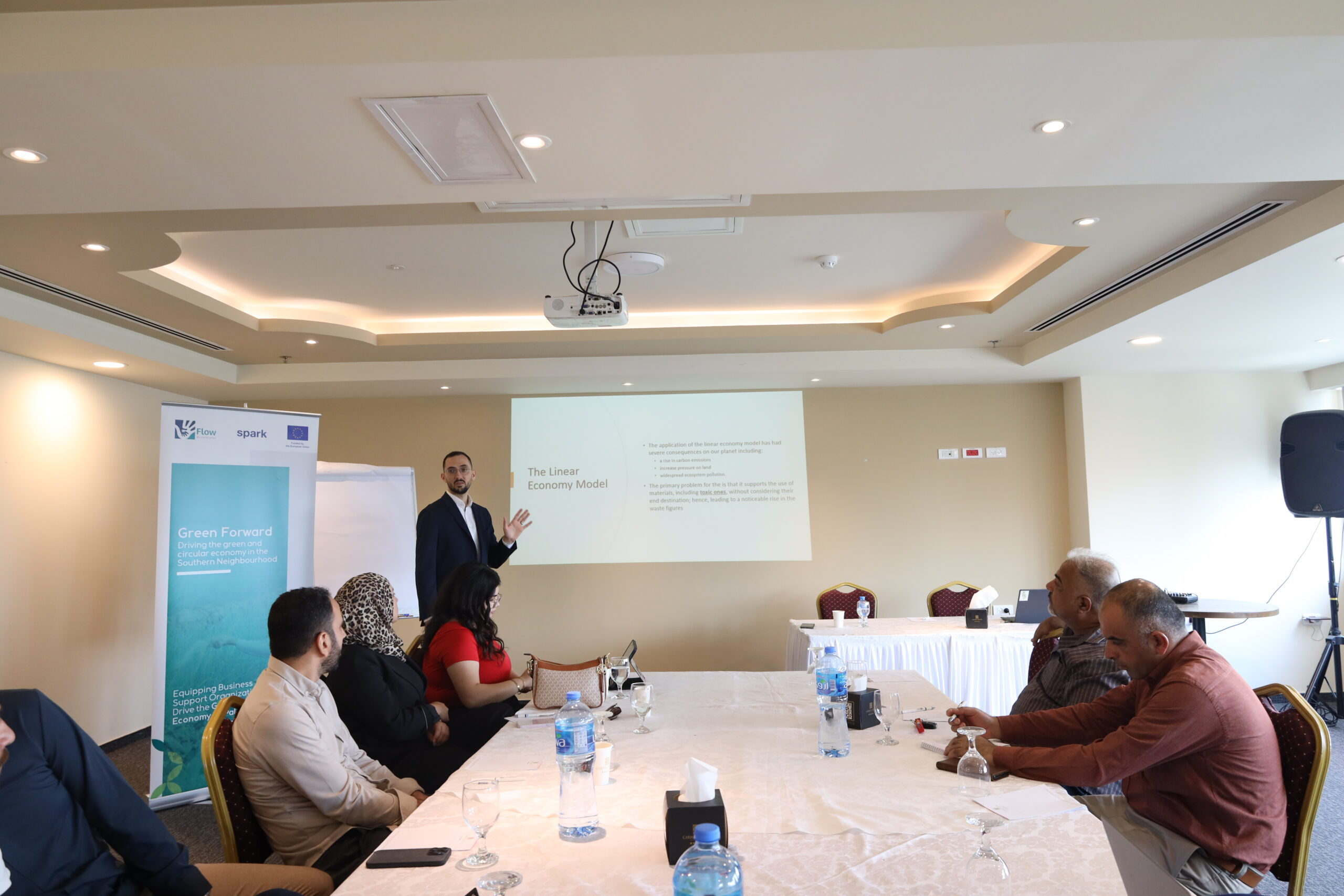
On August 11, 2025, the Green Forward Program’s advanced Green Scale Lab track delivered its second high-level training module, Circular Economy Models, to participating Business Support Organizations (BSOs). The session brought together a dynamic mix of technical experts with ecosystem actors to explore how circular approaches can replace the outdated “take–make–dispose” model with systems that are regenerative, resource-efficient, and resilient.
The training was jointly facilitated by Dr. Yazan Osaily, International Director & Head of Research & Development at PERSES Group, and Eng. Abdelnasser Dweikat, General Manager of the National Carton Industry Company, combining global frameworks with deeply contextualized Palestinian examples.
Dr. Osaily opened the session by confronting participants with the stark realities of today’s global resource use. Every year, the world extracts over 100 billion tonnes of raw materials, with the built environment alone consuming nearly 40% of this volume. Yet, less than 9% of materials are cycled back into productive use. Global municipal solid waste now exceeds 2 billion tonnes annually—a figure expected to reach 3.4 billion tonnes by 2050.
This waste crisis, he explained, is largely the product of the linear economy model—the “make-use-dispose” approach that dominates industrial systems. In this model, products are manufactured without sufficient thought to their end-of-life, leading to value destruction: high-grade metals are downcycled into inferior alloys, quality glass is crushed for aggregate rather than remade into bottles, and textiles are shredded into rags instead of being re-manufactured into garments. According to Bisello et al., 2018, nearly 80% of resources at their end-of-life become waste under this model.
The alternative, Dr. Osaily emphasized, is the circular economy—a systemic shift that designs out waste, keeps materials in use for as long as possible, and regenerates natural systems. He walked participants through the history of the concept, from early works by Boulding (1966) and Stahel & Reday (1976) to the influential frameworks developed by the Ellen MacArthur Foundation and its widely recognized Butterfly Diagram.
Participants engaged in interactive exercises to:
- Define the circular economy and compare it to the linear model.
- Distinguish between reuse and recycling, and between upcycling and downcycling.
- Map a linear vs. circular supply chain for familiar products such as smartphones, cotton T-shirts, and packaged sandwiches.
Dr. Osaily also outlined core principles that underpin circular thinking—designing for the future, retaining the highest value for the longest possible time, using renewable resources, and adapting strategies to context. He stressed that there is no single universally accepted list of principles; rather, they are drawn from diverse schools of thought and tailored to the specific challenges, sectors, and audiences being addressed.
Participants were introduced to practical toolkits for circular economy adoption—such as circular business model canvases, resource efficiency calculators, and waste flow mapping tools—that BSOs can use with MSMEs.
Two international case studies were explored in detail:
- Park 20|20, Netherlands – the first business park built on cradle-to-cradle principles, designed for deconstruction and adaptability, incorporating biodiversity conservation into its landscaping, and demonstrating how commercial spaces can be future-proofed for multiple uses.
- Philips Lighting-as-a-Service – a product-as-a-service model in which Philips retains ownership of lighting equipment, offers lighting as a subscription service, and takes back materials at end-of-life for high-quality reuse or recycling.
These examples illustrated not only the technical feasibility of circular approaches but also the business advantages—cost savings, reduced environmental footprint, and stronger customer relationships.
Shifting to the Palestinian context, Eng. Abdelnasser Dweikat provided a sector-by-sector analysis of current circular economy practices in the country. He acknowledged that while the term “circular economy” may be relatively new to many local businesses, several industries already engage in forms of circularity—whether through informal reuse, repair, or material recovery.
He outlined four key challenges to scaling these practices:
- Infrastructure Gaps – Limited recycling plants and processing facilities for industrial and post-consumer waste.
- Regulatory Fragmentation – A lack of cohesive policies and enforcement mechanisms to incentivize or mandate circular practices.
- Market Limitations – Insufficient consumer demand for recycled or upcycled products.
- Technical Capacity Gaps – Limited know-how among MSMEs to redesign operations for circularity.
Despite these barriers, Eng. Dweikat emphasized emerging opportunities. Several Palestinian case studies were shared, demonstrating that circular models can thrive even in constrained environments. From small recycling enterprises that generate local jobs to manufacturing innovations that extend product lifecycles, these examples underscored the potential for scaling circularity with targeted BSO support.
Participants were also introduced to “The Role of BSOs in Supporting MSMEs through Circular Economy Strategies.” Ideas included:
- Developing tailored advisory programs for MSMEs transitioning to circular models.
- Connecting MSMEs with local and international green finance opportunities.
- Advocating for policies that create economic incentives for circular innovation.
The Circular Economy Models training module reinforced the Green Scale Lab’s mission: to position BSOs not only as service providers, but as catalysts for systemic change, capable of guiding Palestine’s MSMEs toward more sustainable, competitive, and resilient futures.