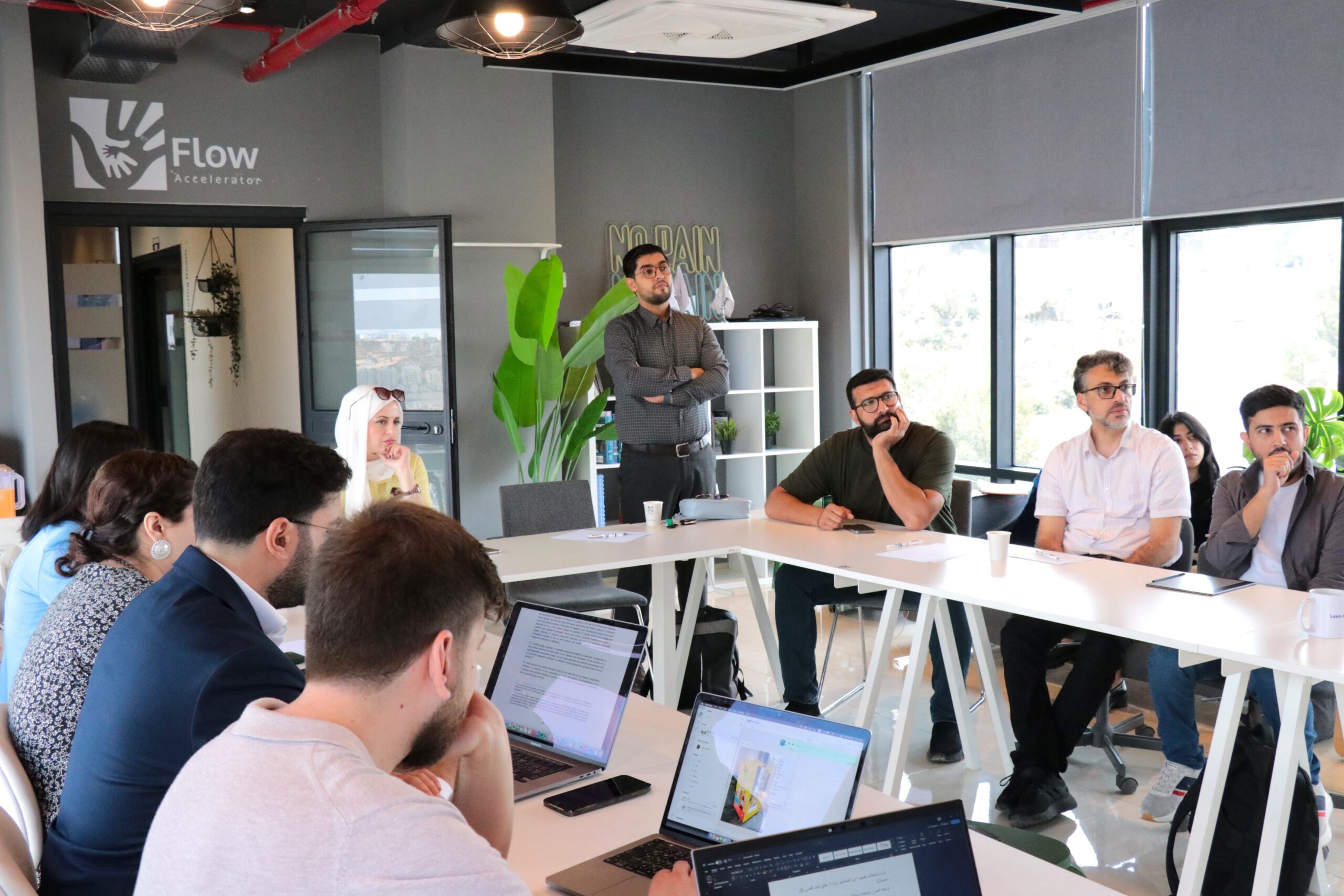
As part of the Green Launchpad track of the Green Forward Program, Flow Accelerator hosted the Collaborative Innovation for Green Technology Roundtable at its headquarters in Al-Tireh, Ramallah. Facilitated by Eng. Abdelnasser Dweikat, General Manager of the National Carton Industry and a respected environmental consultant, the roundtable was carefully designed to move participants through a structured yet dynamic journey that encouraged open dialogue, learning, and co-creation.
The roundtable began with a framing introduction that set the scene for why green technology matters in Palestine and why collaborative innovation is necessary to advance it. From the outset, the session was positioned not as a traditional seminar but as a working space where BSOs, SMEs, and startups could engage with one another on equal footing. The facilitator highlighted the importance of com
bining technical expertise with practical market knowledge, ensuring that the conversation remained both aspirational and grounded in the realities of doing business in Palestine.
The opening segment took the form of a moderated panel where three enterprises were invited to share their stories and insights:
- Snipe, a leading provider of precision fertilization and irrigation systems, spoke about its role in transforming agriculture through sustainable technology.
- FlowLess, a social enterprise specializing in smart water management solutions, demonstrated how IoT and AI are reshaping water distribution systems for municipalities and farmers.
- Al-Wafa Plastic Industries, an established SME in the packaging sector, reflected on how a conventional industry like plastics can also begin to explore greener practices.
Each speaker was given time to present, but more importantly, to spark reflection in the room about what green innovation looks like in Palestine, how it is defined locally, and where opportunities and bottlenecks exist.
Building on these case stories, the session transitioned into a collective dialogue that invited all participants to contribute. The facilitator guided the discussion with questions that encouraged participants to consider emerging trends in green innovation, the coordination gaps that hold back progress, and the role of partnerships in enabling practical solutions. This stage was not about producing quick answers, but about allowing a range of perspectives—from support organizations to entrepreneurs—to be heard and validated.
The final part of the roundtable shifted into group work. Participants were arranged into smaller, mixed groups, blending BSOs with SMEs and startups to ensure diversity of thought. Each group was tasked with discussing shared challenges, exploring opportunities for collaboration, and sketching the outline of possible pilot ideas that could, in time, evolve into joint initiatives. This interactive exercise provided space for participants to think creatively while drawing on the insights they had heard earlier in the day. Groups later reconvened in plenary to share back their reflections, creating an atmosphere of peer learning where different viewpoints could be compared and contrasted.
The facilitation style throughout the session was deliberately participatory. Eng. Dweikat combined his technical expertise with a light-touch approach that gave participants ownership of the dialogue. The design balanced structured input with open exploration, anchoring the session in real examples while leaving room for participants’ own creativity and priorities to shape the discussion.
What made this roundtable distinctive was its flow. It did not remain static in one format, but instead took participants through a sequence: from an opening frame that established shared context, to lived examples presented by innovators, into collective reflection, and finally into hands-on group co-design. This progression created momentum and energy, ensuring that participants were not just listening but actively contributing throughout the day.
The Collaborative Innovation for Green Technology Roundtable exemplified the Green Launchpad’s approach of positioning BSOs as facilitators of ecosystem dialogue and co-creators of solutions. By structuring the session around both knowledge exchange and practical interaction, the roundtable provided a living example of how collaborative processes can strengthen the foundation for green innovation in Palestine.
The Green Forward programme is funded by the European Union and is implemented at the meso level by SPARK and Flow Accelerator in Palestine to foster a green and circular economy (GCE) in the Southern Neighbourhood region.