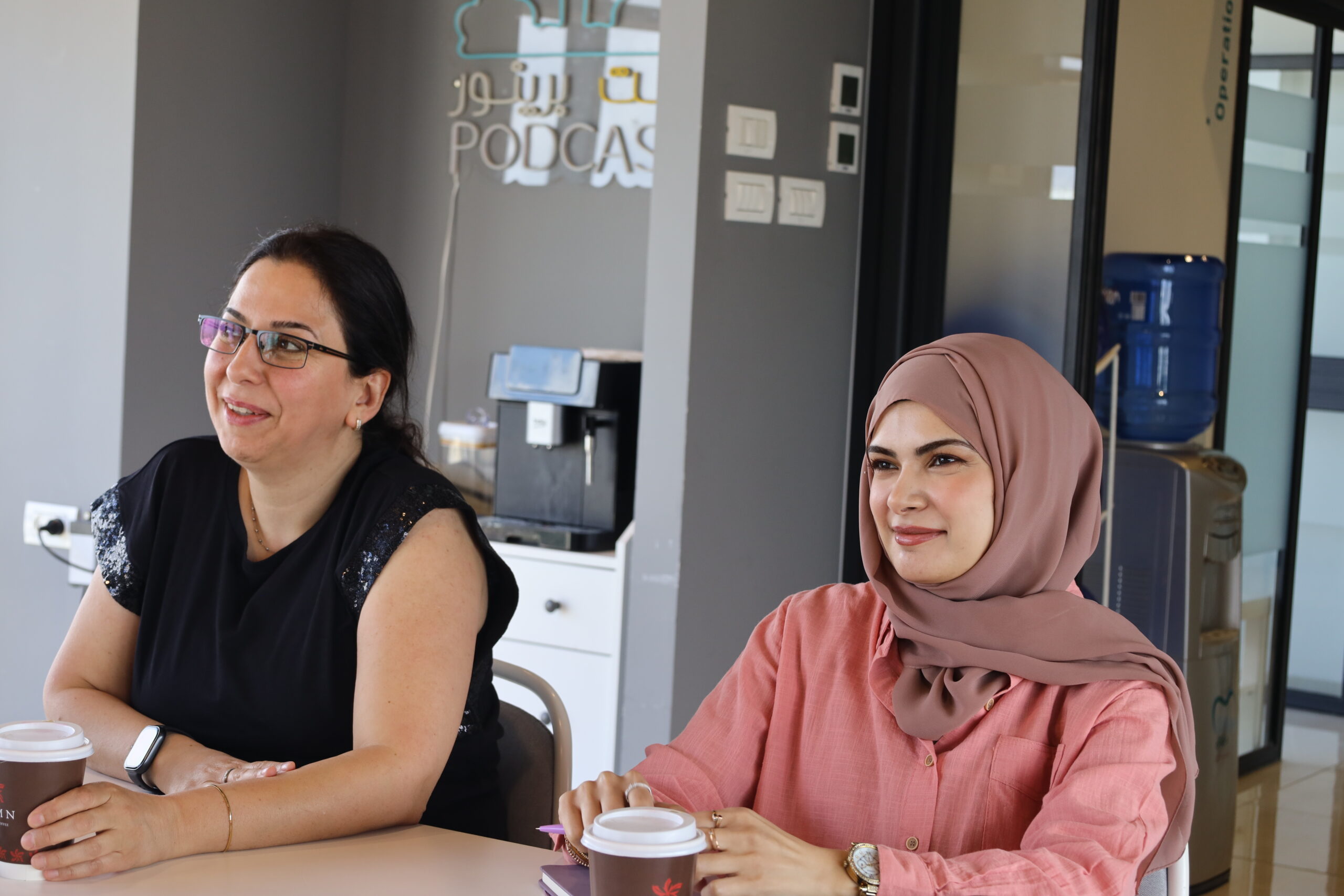
On September 8, 2025, the Green Forward Program’s Green Scale Lab track held its fourth core training module: Innovation and Green Business Development. The session was facilitated by Eng. Abdelnasser Dweikat, General Manager of the National Carton Industry and a seasoned environmental consultant and brought together the advanced Business Support Organizations (BSOs) participating in the track The Applied Research Institute – Jerusalem ARIJ, the Palestine Green Building Council PalGBC, and the Economic & Social Development Centre ESDC.
The session aimed to enhance the capacity of BSOs to become effective enablers of innovation-driven green enterprises. It introduced participants to practical tools and methodologies for developing and scaling sustainable business models, while showcasing sector-specific green technologies across cleantech, agritech, and eco-innovation. In addition, the session emphasized inclusive strategies tailored to Palestine’s entrepreneurial ecosystem, ensuring that youth, women, and underrepresented groups are meaningfully engaged in green innovation.
The day began with a deep dive into the foundations of innovation, distinguishing between creativity, invention, and innovation, and positioning innovation as a driver of economic and environmental transformation. Participants were reminded that green innovation is not only about new ideas, but about building scalable models that deliver environmental, social, and financial value simultaneously.
The first segment of the training focused on tools and global sectoral examples. Eng. Dweikat presented practical guidance on applying the Green Business Model Canvas, encouraging participants to use it to rethink how MSMEs can integrate sustainability into their value propositions. He then highlighted innovations in three core green technology sectors:
- Cleantech, including renewable energy systems and waste-to-resource models.
- AgriTech, such as hydroponic and vertical farming, smart irrigation, and soil-less agriculture.
- Eco-Innovation, with examples like sustainable packaging, recycling, and circular product design.
These global insights were paired with Palestinian case examples, from recycled plastic innovations to solar-powered agricultural systems, underscoring how local entrepreneurs are already testing and adapting solutions that meet the realities of Palestine.
The training then introduced digital tools for monitoring and efficiency, such as IoT platforms and dashboards that help MSMEs optimize energy, water, and production processes. Participants explored how BSOs can guide startups and SMEs to adopt these tools, enhancing competitiveness while reducing environmental footprints.
The second half of the session shifted focus to the Palestinian innovation ecosystem. Through ecosystem mapping, BSOs analyzed the roles of incubators, accelerators, technoparks, and universities, while also recognizing gaps in access to finance, infrastructure, and regional linkages. Eng. Dweikat stressed that innovation ecosystems flourish when multiple actors collaborate—government, private sector, academia, and civil society—and when BSOs act as connectors and conveners.
A dedicated section addressed gender and youth inclusion in green innovation, highlighting how BSOs can use gender-sensitive frameworks and youth-focused programs to create opportunities for underrepresented groups. This emphasis ensured that innovation is not only technologically advanced but also socially inclusive.
By the end of the training, participants had gained a comprehensive understanding of tools, technologies, and strategies to foster green innovation. They left with clearer insights into how BSOs can co-create solutions with entrepreneurs, connect them to ecosystems of support, and advocate for enabling policies.
This session marked another important step in the Green Scale Lab’s mission to position Palestinian BSOs as leaders of the green transition, capable of enabling MSMEs to scale sustainable solutions that address both economic challenges and environmental imperatives.
The Green Forward programme is funded by the European Union and implemented by SPARK and Flow Accelerator in Palestine to foster a green and circular economy (GCE) in the Southern Neighbourhood region.