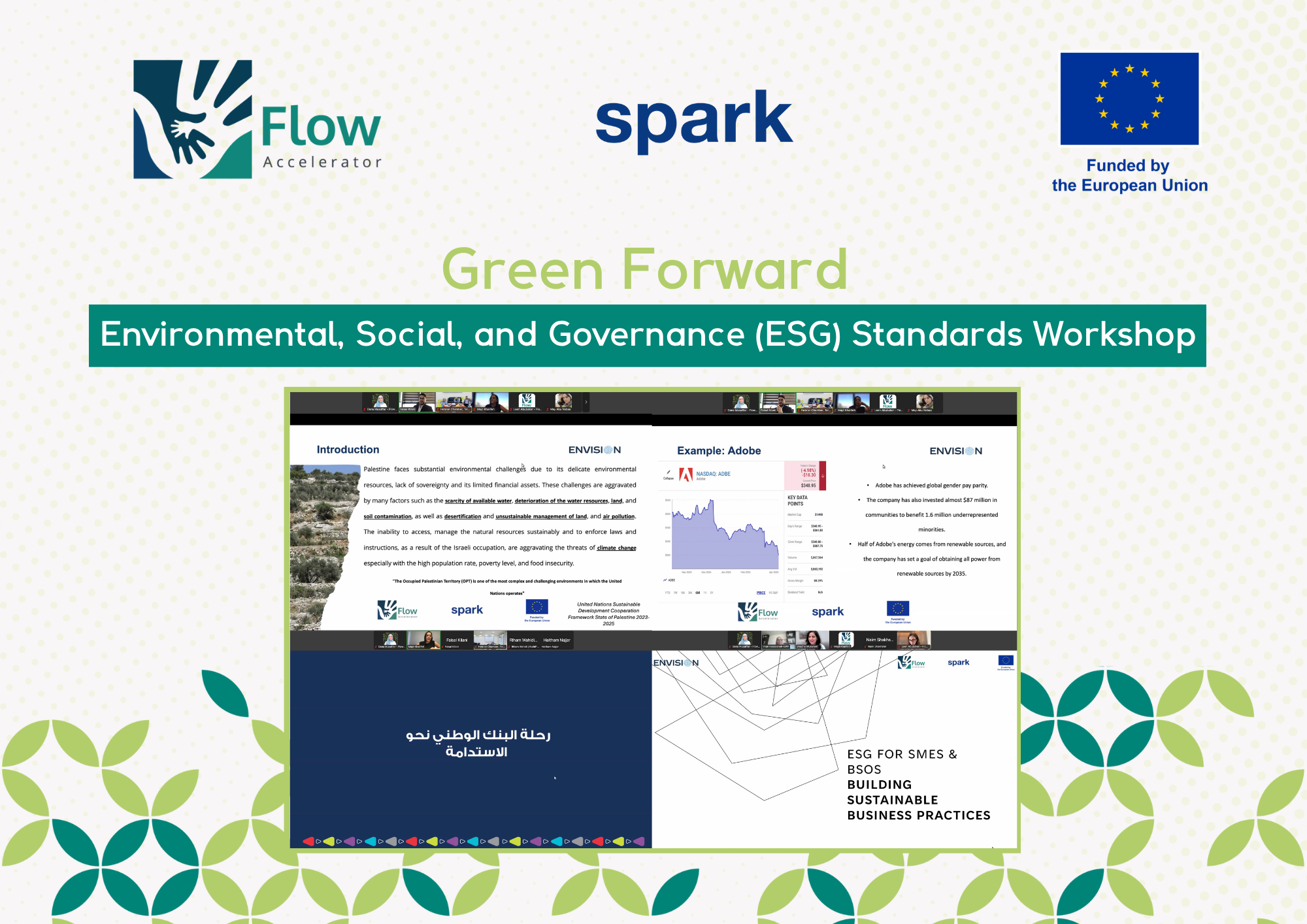
Despite growing movement restrictions and uncertainties across the West Bank, the Green Forward programme successfully held its second workshop under the Green Launchpad track in a fully virtual, highly interactive format on Wednesday, June 25, 2025. This session focused on Environmental, Social, and Governance (ESG) Standards, providing Palestinian Business Support Organizations (BSOs) with practical tools and real-world insights to integrate ESG principles into their support to MSMEs and Startups.
The workshop brought together five BSOs—Hebron Chamber of Commerce and Industry, Businesswomen Forum (BWF), Build Palestine, Rural Women Development Society (RWDS), and the Innovation Hub at An-Najah University—and featured a lineup of expert speakers offering both strategic and operational perspectives.
The session began with a dive into the foundations of ESG and impact investment, led by Eng. Faisal Kilani, Environmental & Social Development Specialist and Founder of Envision Solutions. Faisal introduced participants to the evolution of ESG, unpacked the distinctions between ESG, CSR, and sustainability, and contextualized the growing relevance of ESG frameworks in the Palestinian MSME landscape. The segment also touched on the fundamentals of impact investing and its potential to channel capital into socially and environmentally responsible ventures.
This workshop also featured a rich case study from The National Bank (TNB). Haitham Najjar, Chief Strategy Officer and Chair of the Sustainability Committee, along with Reem Anani, Public Relations Department Manager, shared TNB’s journey of integrating ESG into its business operations. Najjar emphasized the bank’s top-down commitment to sustainability, starting from board-level support through to department-level objectives. He also discussed success stories in areas such as increasing the green finance portfolio, advancing gender equity in leadership roles, reducing greenhouse gas emissions, and leveraging digital technology to improve outreach and efficiency. The bank’s alignment with GRI standards for sustainability reporting and its plan to allocate 50% of 2024 net profits to humanitarian and social causes were also highlighted.
Shadha Musallam, CEO of Agritopia for Agricultural Technology and Environmental Scientist, led a comprehensive breakdown of how Environmental, Social, and Governance (ESG) standards translate into tangible business practices, especially within the Palestinian SME and BSO context. Drawing on her expertise in agricultural technology and environmental consulting, she guided participants through real-life applications, analytical tools, and sector-specific insights.
She gave with a detailed overview of each ESG pillar:
- Environmental (E): Focused on issues such as emissions, water and energy efficiency, waste management, and climate risk exposure. Shadha emphasized how even small MSMEs can make impactful changes, particularly in sectors like agriculture and food production, by applying better energy usage practices and adopting sustainable sourcing.
- Social (S): Covered fair labor practices, gender equality, community engagement, and customer satisfaction. She highlighted the role of inclusive hiring policies and workplace safety as essential elements that boost both brand and employee loyalty.
- Governance (G): Addressed transparency, leadership accountability, stakeholder engagement, and anti-corruption. Shadha stressed the value of well-defined internal policies, documentation standards, and governance structures that are adaptable to Palestinian organizational realities.
Further, she introduced the concept of economic decoupling, explaining how sustainable business practices enable organizations to grow financially without increasing environmental damage—an especially relevant consideration in fragile economies like Palestine’s.
Within hands-on content focused on equipping BSOs with practical tools to assess and guide ESG implementation within MSMEs, Shadha walked the BSOs through the following interactive elements:
- Materiality Mapping: Participants learned how to identify and prioritize ESG issues that matter most to their stakeholders. She facilitated a short exercise using a simplified Materiality Matrix Template, helping BSOs visualize how to weigh relevance vs. impact.
- Self-Checklist Tool: Introduced as a diagnostic instrument, this checklist enabled organizations to evaluate their current ESG readiness and highlight areas for improvement.
- Action Plan Template: Shadha shared a step-by-step guide for converting ESG findings into actionable initiatives. She emphasized goal-setting, internal ownership, and periodic review.
- Stakeholder Engagement Planning: In a collaborative discussion, she showcased how BSOs can structure engagements with internal teams, MSMEs, and community partners. This included mapping relationships, feedback loops, and trust-building mechanisms essential for ESG adoption.
The workshop concluded with emphasizing the importance of continued collaboration through the ESG PeerPod, which will serve as a platform for piloting ESG tools with MSMEs, sharing field experiences, and co-creating solutions. Despite current logistical challenges, the high level of engagement underscored the BSOs’ strong commitment to embedding sustainability and resilience into their institutional models.
Green Forward remains dedicated to equipping local actors with the tools, knowledge, and networks needed to drive the green transition in Palestine—one workshop at a time.
The Green Forward programme is funded by the European Union and implemented by SPARK and Flow Accelerator in Palestine to foster a green and circular economy (GCE) in the Southern Neighbourhood region.