
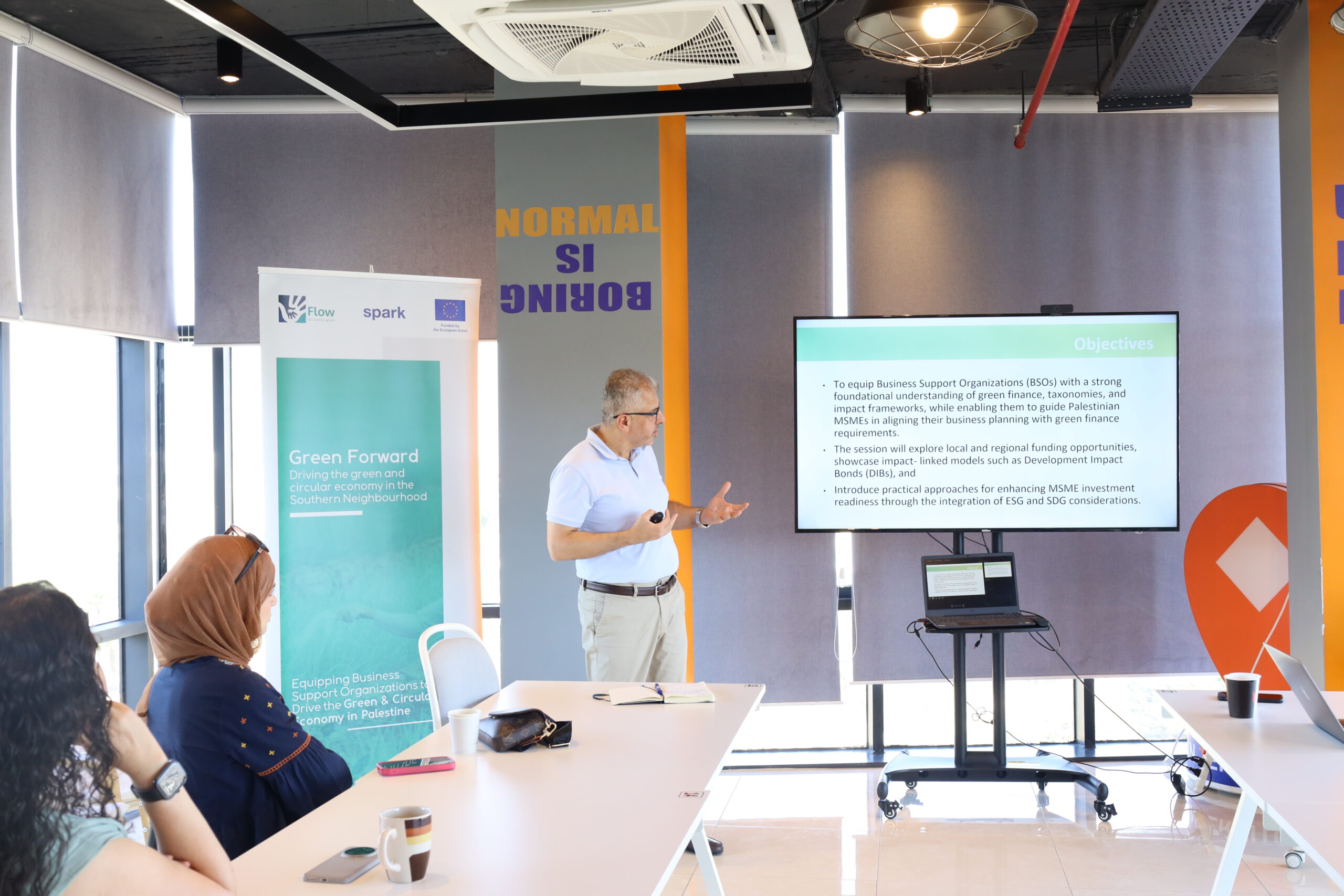
On August 24, 2025, the Green Scale Lab track of the Green Forward Program delivered its third training module, Green Finance, in Ramallah. The session brought together participating Business Support Organizations (BSOs) for an in-depth exploration of how financial innovation, ESG frameworks, and impact-linked mechanisms can unlock new pathways for green entrepreneurship in Palestine. The training was led by Raed Rajab, a seasoned expert and a consultant at the World Bank in Financial Management support for Governance, Energy, and Water.
Green finance is no longer a niche—it is becoming the backbone of climate action and sustainable economic development. Drilling into both global commitments and local realities, participants were reminded that Palestine’s MSMEs represent 99% of the private sector and employ more than 80% of the workforce, making them pivotal players in the green transition. However, limited access to tailored financial instruments continues to hold back their growth and innovation potential.
The training aimed to equip BSOs with the knowledge and tools to address this gap, enabling them to guide MSMEs in aligning business plans with green finance standards, improving investment readiness, and accessing emerging green capital.
Throughout the day, the module aimed to:
- Provide a foundational understanding of green finance, taxonomies, and global frameworks.
- Introduce local and regional funding opportunities available for Palestinian SMEs.
- Demonstrate impact-linked models such as the Development Impact Bond (DIB) with the Finance for Jobs (F4J) case in Palestine.
- Strengthen BSO capacity to evaluate SME readiness for green investment.
- Equip participants with practical tools to integrate ESG and SDG considerations into advisory services.
The session unfolded in stages. First, participants explored the principles of green finance—including taxonomy systems and classification frameworks that define what counts as “green.” They examined the Green Loan Principles (GLP) and discussed why such guidelines are essential for building trust, transparency, and credibility in financial markets.
Participants also learned about the spectrum of sustainable investment, including ESG investing, socially responsible investment (SRI), and impact investment, with a focus on how SMEs can position themselves across this continuum.
The training highlighted Palestine’s policy and legal frameworks relevant to green investment, including the Environmental Law, the Renewable Energy and Energy Efficiency Law, and the updated Nationally Determined Contributions (NDCs) that commit to significant emission reductions by 2030 and 2040.
Despite these policy signals, participants recognized systemic constraints:
- Financing gaps estimated at USD 5.9 billion to meet NDC targets.
- Limited institutional readiness in local banks and investment funds.
- Challenges in securing environmental certifications for SMEs.
At the same time, opportunities were flagged in renewable energy, sustainable agriculture, waste management, and eco-innovation—sectors where MSMEs could deliver both environmental and financial returns if supported effectively.
One of the highlights of the training was the introduction to impact investing, where participants explored both global and regional perspectives on how capital can be deployed not only for financial returns but also for measurable social and environmental impact. This segment also covered an overview of Social Impact Bonds (SIBs) as an innovative financing mechanism that links investor returns to the achievement of specific social outcomes.
The discussion then turned to the Palestinian experience, with a deep dive into the Finance for Jobs (F4J) Development Impact Bond (DIB)—the first of its kind in Palestine. Presented by Jalil Hazboun, Executive Director of F4J Consulting Services, the case illustrated how results-based financing can channel private capital into socially impactful projects, with investors repaid only if pre-agreed outcomes are achieved. The session examined the successes of the model, such as mobilizing private sector engagement and piloting new ways of financing job creation, alongside its challenges, including transaction complexity and the need for robust data systems. Lessons learned from the DIB experience provided BSOs with a concrete example of how impact investment models can be designed, localized, and adapted to Palestinian realities
This Green Finance and Impact Investment training reinforced the mission of the Green Scale Lab: to prepare Palestinian BSOs to serve not only as advisors, but as connectors to finance and investment, enabling MSMEs to scale sustainable solutions. By equipping BSOs with financial knowledge and practical tools, the session laid the groundwork for bridging the persistent finance gap that holds back the growth of green SMEs in Palestine.
The Green Forward programme is funded by the European Union and implemented by SPARK and Flow Accelerator in Palestine to foster a green and circular economy (GCE) in the Southern Neighbourhood region.